
Back to Blogs
PPC

Google Ads for Small Business

Jun 3, 2026 By ClieVox 5 min read

The Complete Guide to Generating More Leads

Running a small business has never been easy, but in today's digital landscape, attracting consistent leads and customers can feel more challenging than ever. Competition continues to increase across nearly every industry, customer expectations are constantly evolving, and businesses that once relied on referrals and word-of-mouth marketing are discovering that these traditional methods alone are no longer enough to support sustainable growth. While referrals remain valuable, they are difficult to predict, impossible to scale on demand, and often leave business owners wondering where their next customer will come from.

This uncertainty is exactly why more business owners are turning to Google Ads for small business growth. Unlike many forms of traditional marketing that interrupt consumers with messages they did not ask to see, Google Ads allows your business to appear when someone is actively searching for the products or services you offer. Instead of hoping potential customers notice your advertisement, you place your business directly in front of people who are already looking for solutions.

Imagine owning a roofing company, dental clinic, law firm, landscaping service, accounting practice, or home remodeling business. Every day, people search Google using phrases such as "roof repair near me," "best dentist in Nairobi," "small business accountant," or "kitchen renovation contractor." These searches represent real buying intent. The person performing the search has a problem and is actively looking for someone who can solve it. By appearing at the top of search results, your business gains immediate visibility at one of the most important moments in the buyer's journey.

This guide will show you how Google advertising for small business works, what it costs, how PPC fits into a broader marketing strategy, and why combining advertising with content marketing, video marketing, and social media can create a predictable system for generating qualified leads.

Why Google Advertising for Small Business Works So Well

One of the primary reasons Google advertising for small business remains so effective is because it is built around customer intent. Unlike billboard advertising, newspaper ads, radio commercials, or even many social media campaigns, Google Ads targets people who are already looking for a solution.

Consider the difference between these two scenarios.

In the first scenario, a business owner is scrolling through social media and sees an advertisement for bookkeeping services. While they may eventually need those services, bookkeeping is not necessarily top of mind at that moment.

In the second scenario, the same business owner searches Google for "small business bookkeeping services near me." The intent is completely different. They are actively researching providers and are likely much closer to making a purchasing decision.

This distinction is incredibly important because it means Google Ads often attracts higher-quality leads than many other forms of advertising.

Benefits of Google Ads for Small Businesses

Google Ads offers several advantages that make it particularly attractive for small and medium-sized businesses:

Immediate Visibility

Unlike search engine optimization, which can take several months to generate meaningful results, Google Ads can begin driving targeted traffic almost immediately after a campaign launches.

Geographic Targeting

Local businesses can focus their advertising budget on specific cities, counties, neighborhoods, or service areas, ensuring they reach customers who are actually within their market.

Budget Control

Businesses maintain complete control over spending. Whether your monthly budget is $300 or $30,000, campaigns can be structured to align with your financial goals.

Measurable Results

Every click, phone call, form submission, and conversion can be tracked, allowing businesses to understand exactly where their marketing budget is producing results.

Scalability

Successful campaigns can be expanded gradually, allowing businesses to increase spending as revenue grows.

customer-journey

This simple funnel demonstrates why search advertising continues to be one of the most effective customer acquisition channels available today.

Understanding Google Advertising Cost for Small Business

One of the most common questions business owners ask is, "How much does Google Ads cost?"

The answer depends on several factors, including industry competition, geographic location, keyword demand, and campaign quality.

Many people assume Google Ads is expensive because they hear stories about businesses spending thousands of dollars each month. The reality is that Google Ads operates on an auction system, meaning advertisers compete for visibility based on both bid amount and ad quality.

Factors That Influence Cost

Several variables determine what you pay for each click:

Industry Competition

Highly competitive industries generally experience higher costs per click because multiple advertisers are competing for the same audience.

Examples include:

  • Legal services
  • Insurance
  • Financial services
  • Home services
  • Marketing agencies

Geographic Location

Advertising in major metropolitan areas often costs more than advertising in smaller cities due to increased competition.

Keyword Intent

Keywords indicating strong buying intent typically cost more because they are more likely to generate revenue.

For example:

  • "Emergency plumber near me"

This keywords often cost more than informational searches because they are closer to a purchasing decision.

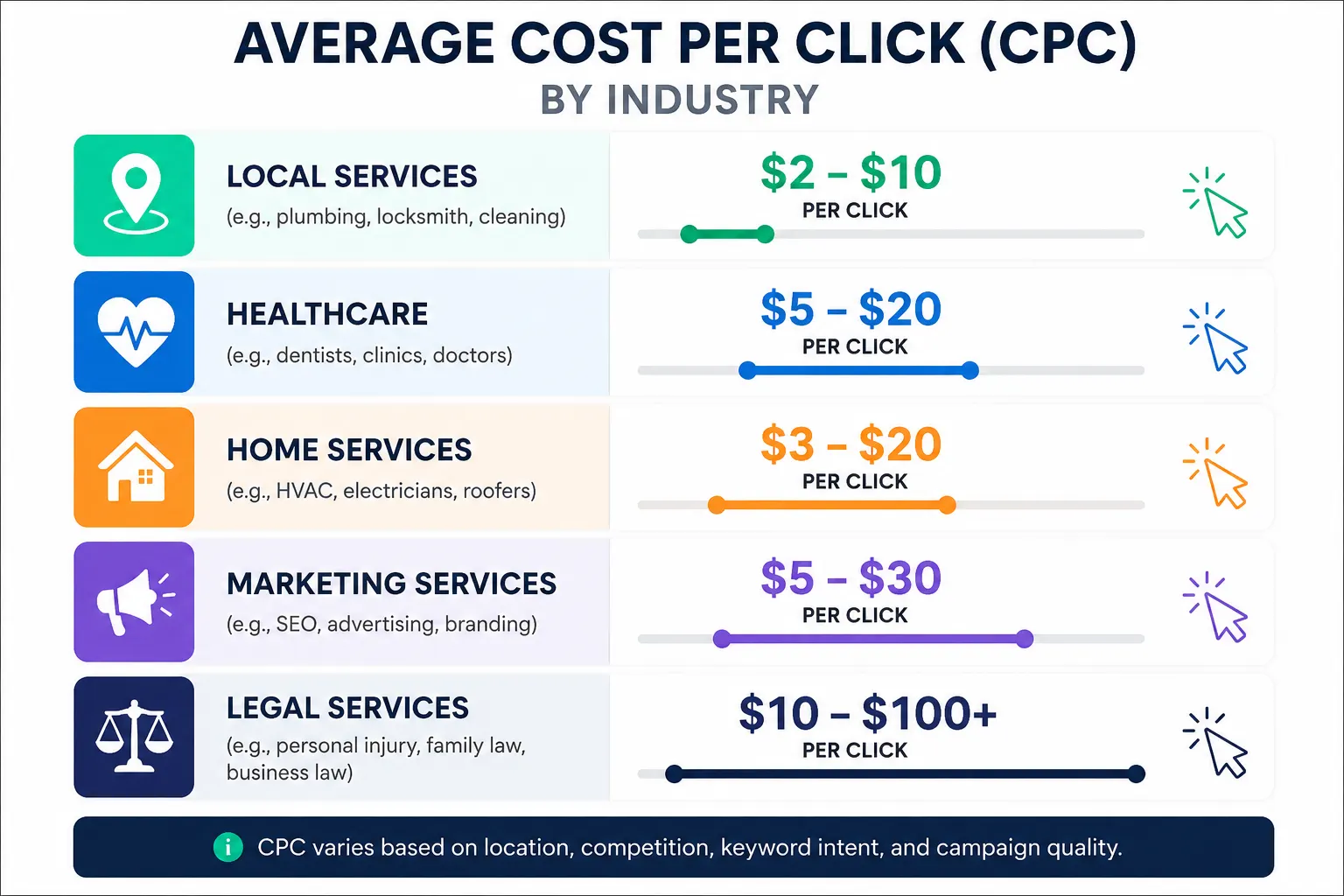
Average Cost Per Click by Industry

Industry

Average CPC Range

Local Services

$2 - $10

Healthcare

$5 - $20

Legal Services

$10 - $100+

Marketing Services

$5 - $30

Home Improvement

$3 - $20

While these costs may initially seem high, successful advertisers focus on profitability rather than click costs.

For example, if a roofing contractor pays $15 per click and converts one customer for every 20 clicks, the acquisition cost would be approximately $300. If the average roofing project generates $5,000 or more in revenue, the campaign remains highly profitable.

According to Google Ads industry benchmarks, businesses earn approximately $2 for every $1 spent on Google Ads on average, although results vary significantly based on industry, targeting, landing page quality, and campaign management.

The Biggest Cost Mistake Small Businesses Make

Many small business owners focus entirely on reducing click costs when they should be focusing on increasing profitability.

A cheaper click does not necessarily produce better results.

A $2 click that never converts is more expensive than a $20 click that consistently generates profitable customers.

The goal should always be maximizing return on investment rather than minimizing advertising costs.

PPC for Small Business: What It Means and Why It Matters

PPC stands for Pay-Per-Click advertising, a model where businesses pay only when someone clicks on their advertisement. Rather than paying for exposure alone, advertisers pay when users actively engage with their ads.

This makes PPC one of the most measurable forms of marketing available.

While Google Ads is the most widely known PPC platform, it is far from the only option available to businesses.

Major PPC Platforms

Google Ads: Captures high-intent traffic from people actively searching for solutions.

Microsoft Ads: Offers access to Bing users and often delivers lower competition than Google.

Facebook Ads: Excellent for building awareness and targeting audiences based on interests and demographics.

Instagram Ads: Particularly effective for visual products and lifestyle brands.

LinkedIn Ads: Ideal for B2B companies targeting decision-makers and professionals.

YouTube Ads: Powerful for brand awareness, education, and product demonstrations.

The best platform depends on your industry, audience, and objectives. However, Google Ads typically serves as the foundation because it captures demand that already exists rather than creating demand from scratch.

Why PPC Is Attractive for Small Businesses

The biggest advantage of PPC is speed.

Search engine optimization can take months to build momentum. Referral programs take time to develop. Social media audiences require consistent nurturing.

PPC can begin generating qualified traffic almost immediately.

This speed allows businesses to test offers, validate demand, generate leads, and create revenue while simultaneously investing in longer-term marketing initiatives.

google-ads-performance-report

This helps readers visualize how campaign performance is measured.

Paid Advertising for Small Business Beyond Google

While Google Ads often becomes the centerpiece of a lead generation strategy, businesses that achieve consistent growth understand that customers rarely make decisions after a single interaction. Modern buyers conduct research across multiple channels, compare options, read reviews, watch videos, visit websites, and seek validation before making a purchase. This means businesses that rely exclusively on one advertising platform may miss opportunities to influence prospects during critical stages of the buying process.

Think about your own purchasing behavior. If you are considering a significant investment such as hiring a contractor, purchasing software, selecting a marketing agency, or choosing a financial advisor, you probably do not make your decision after clicking one advertisement. Instead, you gather information from multiple sources before deciding who deserves your trust.

This is why paid advertising for small business should be viewed as a complete ecosystem rather than a single channel.

How Different Advertising Platforms Support Business Growth

Each advertising platform serves a unique purpose within the customer journey.

Platform

Best For

Customer Intent

Typical Outcome

Google Ads

Active searchers

Very High

Leads and sales

Facebook Ads

Awareness and engagement

Medium

Brand exposure

Instagram Ads

Visual storytelling

Medium

Engagement and inquiries

LinkedIn Ads

B2B targeting

High

Qualified business leads

YouTube Ads

Education and trust building

Medium

Brand awareness

For example, a homeowner who urgently needs a plumber is likely to search Google immediately because they require a solution right away. On the other hand, a business owner considering marketing services may first encounter educational content on LinkedIn, watch a case study on YouTube, and only later conduct a Google search when they are ready to hire an agency.

The businesses that consistently outperform competitors understand how to leverage multiple channels to stay visible throughout the buying journey. Rather than asking which platform is best, successful marketers ask how each platform can contribute to generating awareness, building trust, and converting prospects into customers.

The Importance of Diversification

Many businesses become overly dependent on a single source of leads. This creates unnecessary risk because changes in advertising costs, platform algorithms, or competitive activity can significantly impact performance.

A diversified marketing strategy offers several advantages:

  • Reduced dependence on one channel
  • Greater visibility across the customer journey
  • Improved brand recognition
  • More opportunities for remarketing
  • Better long-term lead stability

customer-attribution-journey

This visual helps readers understand how multiple marketing channels work together rather than competing against each other.

Content Marketing for Small Businesses

If advertising is the engine that drives traffic to your website, content marketing is the system that transforms visitors into buyers.

One of the biggest misconceptions in digital marketing is that generating traffic automatically leads to sales. While attracting visitors is important, traffic alone does not create revenue. Prospects need information, reassurance, and proof that your business can solve their problems before they feel comfortable making a purchasing decision.

This is where content marketing for small businesses becomes essential.

Content marketing involves creating valuable resources that educate, inform, and guide potential customers throughout the decision-making process. Rather than aggressively selling, content marketing helps prospects understand their challenges and evaluate possible solutions.

When executed properly, content marketing creates trust before the first sales conversation ever takes place.

Why Content Marketing Works

Consumers have become increasingly skeptical of traditional advertising because they understand that advertisements are designed to persuade. Educational content feels different because its primary purpose is to help.

When someone discovers a useful article that answers their question, provides actionable advice, or solves a specific problem, they begin associating your brand with expertise and credibility.

Over time, this trust compounds.

Benefits of Content Marketing for Small Businesses

Improved Search Engine Rankings

Google rewards websites that consistently publish useful, relevant, and authoritative content. Every article creates another opportunity to rank for valuable search terms.

Lower Customer Acquisition Costs

Unlike advertising campaigns that stop producing results when budgets are paused, quality content continues attracting visitors long after publication.

Increased Trust and Authority

Businesses that consistently educate their audience position themselves as experts within their industry.

Better Lead Quality

Prospects who consume educational content often arrive better informed and more prepared to make purchasing decisions.

Stronger Support for Advertising Campaigns

Advertising and content marketing work exceptionally well together because ads generate traffic while content builds trust.

customer-journey-stages

This visual demonstrates how content supports the entire sales process rather than simply attracting website visitors.

The Compounding Effect of Content

One of the most powerful aspects of content marketing is its ability to generate long-term returns.

Imagine publishing one article every week for a year.

At the end of twelve months, you would have more than fifty pieces of content working on your behalf twenty-four hours a day. Each article becomes another opportunity for prospects to discover your business through search engines, social media, email campaigns, and referrals.

This compounding effect is one reason content marketing remains one of the highest-return marketing investments available to small businesses.

Content Marketing Strategies for Small Business

Creating content without a strategy often leads to frustration because random publishing rarely generates meaningful results. Effective content marketing begins with understanding your customers, identifying their questions, and producing content that addresses their needs.

The goal is not simply to publish more content. The goal is to publish content that helps prospects move closer to a purchasing decision.

1. Answer Customer Questions

The most successful business blogs focus on answering questions that potential customers already ask.

Examples include:

  • How much does Google Ads cost?
  • Is PPC worth it for small businesses?
  • How can I generate more leads?
  • What is the difference between SEO and PPC?
  • Should I hire a marketing agency?

Every question represents a potential content opportunity.

2. Create Local Content

Businesses serving specific geographic markets should create location-focused content.

Examples include:

  • Best marketing strategies for businesses in Nairobi
  • Local SEO tips for small businesses
  • How to attract more customers in your city

Local content helps improve visibility for geographically targeted searches while demonstrating familiarity with local markets.

3. Publish Case Studies

Case studies provide evidence that your business delivers results.

Instead of making claims about your expertise, case studies allow prospects to see actual outcomes.

Effective case studies should include:

  • Client challenge
  • Strategy implemented
  • Results achieved
  • Key lessons learned

sales-comparison-results

4. Build Lead Magnets

Not every visitor is ready to buy immediately.

Lead magnets provide value in exchange for contact information, allowing businesses to continue nurturing prospects through email marketing.

Examples include:

  • Marketing checklists
  • Budget calculators
  • Industry guides
  • Templates
  • Worksheets

5. Repurpose Existing Content

Many businesses create one piece of content and move on to the next topic. High-performing marketers maximize the value of every asset they produce.

One blog article can become:

  • Multiple social media posts
  • An email newsletter
  • A YouTube video
  • An infographic
  • A downloadable guide

This approach significantly increases content efficiency while maintaining consistent messaging across channels.

Video Marketing for Small Business

Consumer behavior has changed dramatically over the past decade, and video content now plays a central role in how people consume information online. Whether prospects are researching products, evaluating service providers, or comparing alternatives, many prefer watching videos rather than reading lengthy blocks of text.

This shift presents a significant opportunity for small businesses.

Video marketing for small business is no longer reserved for large brands with massive production budgets. Modern smartphones, affordable editing tools, and social media platforms have made video creation accessible to businesses of all sizes.

Why Video Builds Trust Faster

People buy from businesses they trust.

Video allows prospects to see the people behind the company, hear explanations directly from experts, and develop familiarity before making contact.

Compared to text alone, video offers:

  • Greater emotional connection
  • Higher engagement
  • Better information retention
  • Stronger brand recognition
  • Improved conversion rates

High-Performing Video Types

Customer Testimonials: Nothing builds credibility faster than satisfied customers sharing their experiences.

Frequently Asked Questions: Video FAQs address common concerns while showcasing expertise.

Product Demonstrations: Demonstrating products in action helps prospects understand value more clearly.

Educational Content: Teaching valuable concepts establishes authority while attracting potential customers.

Behind-the-Scenes Content: Showing how your business operates creates transparency and trust.

According to multiple industry studies, consumers consistently report that video helps them better understand products and services, making video one of the most influential forms of digital content in the buying process.

video-vs-text-performance

Social Media Advice for Small Business Owners

Many business owners feel overwhelmed by social media because they assume success requires constant posting, endless content creation, and participation on every platform. In reality, effective social media marketing is far more strategic.

The goal is not to be everywhere.

The goal is to be present where your audience spends time and to consistently provide value.

Businesses often waste resources trying to master every social network simultaneously when they would achieve better results by focusing on one or two platforms aligned with their audience.

A Simple Weekly Social Media Framework

Monday:
Educational tip or industry insight

Wednesday:
Customer success story or case study

Friday:
Behind-the-scenes content or team spotlight

This simple framework creates consistency without overwhelming business owners.

Best Practices for Social Media Success

  • Respond to comments promptly
  • Showcase customer reviews
  • Share educational content
  • Incorporate video whenever possible
  • Repurpose blog content
  • Focus on engagement rather than follower counts

One of the easiest ways to maintain consistency is by repurposing content from your blog. A single article can easily generate multiple social media posts, allowing businesses to extend the value of every piece of content they create.

Social Media Mistakes to Avoid

Many businesses make the mistake of treating social media as a sales channel rather than a relationship-building platform.

Constant promotional content often leads to lower engagement because audiences primarily use social platforms to learn, connect, and be entertained.

A better approach is following the 80/20 rule:

  • 80% educational, informative, or entertaining content
  • 20% promotional content

This balance helps maintain audience interest while still generating business opportunities.

80-20-rule

The businesses that achieve the greatest success on social media understand that trust is built gradually through consistent value rather than aggressive selling.

When Should You Hire Small Business PPC Services?

Many business owners begin their advertising journey by managing campaigns themselves, and this approach can be beneficial because it helps develop a foundational understanding of how digital advertising works. However, as campaigns become more sophisticated, managing Google Ads effectively requires significant time, ongoing analysis, and continuous optimization. What initially appears simple can quickly become overwhelming as keyword lists grow, competition increases, landing pages require testing, and conversion tracking becomes more complex.

The reality is that many underperforming campaigns fail not because Google Ads is ineffective, but because critical components of the campaign are not properly configured. Discussions among experienced PPC professionals frequently highlight issues such as broken conversion tracking, poor keyword targeting, weak landing page experiences, and a lack of negative keywords as common reasons businesses fail to achieve profitable results.

This creates an important distinction. There is a significant difference between running ads and running profitable ads.

Signs You May Need Professional PPC Support

If any of the following situations sound familiar, it may be time to consider professional PPC management:

Your Advertising Costs Continue to Increase

Rising costs without corresponding improvements in lead quality often indicate optimization opportunities that are being missed.

You Are Receiving Traffic But Not Leads

A healthy click-through rate combined with poor conversion rates frequently points to landing page issues, targeting problems, or messaging misalignment.

You Cannot Track Results Accurately

Without proper conversion tracking, businesses cannot determine which campaigns, keywords, or advertisements are generating revenue.

You Do Not Have Time to Manage Campaigns

Google Ads requires ongoing monitoring and optimization. Busy business owners often struggle to dedicate sufficient time to campaign management.

Lead Quality Is Inconsistent

Generating leads is important, but generating qualified leads is what ultimately drives profitability.

What Small Business PPC Services Typically Include

Professional PPC management generally involves:

  • Keyword research and strategy
  • Campaign creation and structure
  • Ad copy development
  • Landing page recommendations
  • Conversion tracking setup
  • Negative keyword management
  • Bid management
  • Ongoing optimization
  • Performance reporting
  • Strategic growth planning

Rather than simply launching advertisements and hoping for the best, professional management focuses on creating systems that consistently improve campaign performance over time.

Why Businesses Work With a Content Marketing Agency for Small Business Growth

As businesses expand, marketing inevitably becomes more complex. What begins as a simple website and occasional social media post often evolves into a combination of search engine optimization, content creation, paid advertising, video production, email marketing, analytics, and conversion optimization.

Managing all these disciplines internally can become challenging, especially for small businesses where team members are already responsible for multiple operational functions.

A content marketing agency for small business growth helps solve this challenge by providing access to specialized expertise across multiple marketing channels without the expense of hiring a full internal marketing department.

Benefits of Working With a Marketing Agency

Access to Specialized Expertise

Marketing agencies work across multiple industries and campaigns, allowing them to bring insights and proven strategies that may not be available internally.

Faster Execution

Instead of learning every aspect of digital marketing from scratch, businesses can leverage experienced professionals to accelerate results.

Consistent Content Production

Many businesses struggle with consistency. Agencies provide structured processes that ensure content is created and published regularly.

Integrated Marketing Strategies

Rather than treating SEO, PPC, social media, and content marketing as separate initiatives, agencies create cohesive strategies where each channel supports the others.

Better Use of Internal Resources

Business owners and employees can focus on serving customers while marketing specialists manage lead generation efforts.

What to Look for in a Marketing Agency

Not all agencies are created equal. Before selecting a partner, businesses should evaluate:

  • Industry experience
  • Case studies
  • Reporting transparency
  • Communication processes
  • Strategic approach
  • Understanding of business goals

The right agency should function as an extension of your team rather than simply a vendor providing isolated services.

PPC Management for Small Business: DIY vs Professional Management

One of the most common questions business owners ask is whether they should manage advertising campaigns themselves or hire professionals.

The answer depends on several factors, including budget, available time, campaign complexity, and growth objectives.

DIY PPC Management

Advantages

  • Lower initial costs
  • Complete control over campaigns
  • Valuable learning experience
  • Direct access to campaign data

Challenges

  • Steep learning curve
  • Time-intensive management
  • Increased risk of costly mistakes
  • Slower optimization process
  • Limited access to advanced expertise

For businesses with small budgets and sufficient time to learn, DIY management can be a reasonable starting point.

Professional PPC Management

Advantages

  • Faster implementation
  • Better targeting strategies
  • More effective optimization
  • Advanced tracking capabilities
  • Strategic guidance
  • Higher likelihood of profitable growth

Challenges

  • Management fees
  • Need to select the right partner

While professional management involves additional costs, many businesses discover that improved campaign performance more than offsets management expenses.

This is particularly important because advertising costs continue to increase across many industries. According to industry benchmarks, average Google Ads return on ad spend remains approximately 200%, meaning businesses earn around $2 for every $1 spent, although top-performing campaigns often significantly exceed this benchmark through effective optimization.

The goal should never be finding the cheapest clicks. The goal should be generating the most profitable customers.

A Real-World Perspective

Numerous businesses report disappointing advertising results after launching campaigns without a clear strategy. In many cases, issues such as broad keyword targeting, weak landing pages, poor audience alignment, and inadequate conversion tracking contribute more to failure than the advertising platform itself.

This highlights an important lesson for small business owners. Success with Google Ads depends less on spending more money and more on investing intelligently.

Build a Marketing System, Not Just Advertising Campaigns

The most successful businesses understand that sustainable growth comes from creating systems rather than relying on individual tactics.

Google Ads generates visibility.

Content marketing builds authority.

Video marketing develops trust.

Social media strengthens relationships.

Email marketing nurtures leads.

Conversion optimization increases profitability.

When these elements work together, businesses create a predictable lead-generation engine capable of producing results month after month.

Instead of constantly searching for the next marketing tactic, focus on building a complete system where every channel supports the customer journey.

A prospect may discover your business through a Google search, read a blog article, subscribe to your email list, watch a video case study, and eventually schedule a consultation. Each interaction contributes to building confidence and moving that prospect closer to becoming a customer.

The businesses that consistently outperform competitors are rarely the ones using secret tactics. They are usually the businesses executing proven strategies consistently across multiple channels.

Frequently Asked Questions

Is Google Ads worth it for small businesses?

Yes. Google Ads can be highly effective because it targets people who are actively searching for products and services. Businesses that implement proper targeting, conversion tracking, and landing page optimization often generate qualified leads and measurable returns on investment.

How much should a small business spend on Google Ads?

There is no universal budget. Many small businesses begin with budgets ranging from a few hundred dollars to several thousand dollars per month. The appropriate budget depends on industry competition, customer value, and business objectives.

What is the difference between SEO and PPC?

SEO focuses on improving organic visibility in search engines and typically produces long-term results. PPC involves paying for advertisements that generate immediate visibility. Both strategies work best when used together.

How long does it take for Google Ads to generate results?

Unlike SEO, Google Ads can begin generating traffic immediately after campaigns launch. However, optimization often requires several weeks of data collection and testing to achieve peak performance.

What industries benefit most from Google Ads?

Almost every industry can benefit, but Google Ads is particularly effective for service businesses, healthcare providers, legal firms, contractors, home service companies, financial services, software companies, and professional service providers.

Can I manage Google Ads myself?

Yes. Many business owners start by managing campaigns themselves. However, as campaigns become more complex, professional management often improves efficiency and profitability.

What is a good conversion rate for Google Ads?

Conversion rates vary significantly by industry, offer, and traffic source. Rather than comparing yourself to generic benchmarks, focus on improving your own conversion rates over time.

What is the biggest mistake small businesses make with PPC?

One of the most common mistakes is launching campaigns without proper conversion tracking. Without accurate data, businesses cannot determine which keywords, ads, or campaigns are generating revenue.

How often should small businesses publish content?

Consistency matters more than volume. For most small businesses, publishing two to four high-quality articles per month provides a strong foundation for content marketing growth.

Should I invest in content marketing or Google Ads first?

Ideally, businesses should invest in both. Google Ads generates immediate traffic, while content marketing builds long-term authority and organic visibility.

Ready to Generate More Qualified Leads?

Many businesses waste thousands of dollars on advertising campaigns that generate clicks but fail to produce meaningful revenue. Others invest heavily in content creation without a clear strategy for converting visitors into customers.

The businesses that achieve sustainable growth are those that combine Google Ads, content marketing, conversion optimization, and strategic campaign management into a unified system designed to generate measurable results.

Request Your Free Campaign Audit From Clievox

At Clievox, we help small businesses generate more qualified leads through:

ü  Google Ads Management

ü   PPC Management for Small Business

ü  Content Marketing Strategies

ü  Landing Page Optimization

ü  Conversion Tracking Setup

ü  Lead Generation Systems

ü  Local SEO Growth Strategies

ü  Marketing Performance Audits

If your campaigns are underperforming, your lead flow has slowed, or you simply want an expert second opinion on your marketing strategy, our team can help identify opportunities to improve performance and increase return on investment.

Your Free Campaign Audit Includes:

    • Google Ads account review
    • Keyword strategy analysis
    • Landing page evaluation
    • Conversion tracking assessment
    • Competitor insights
    • Actionable recommendations

Request your free campaign audit today and discover how Clievox can help turn your marketing into a predictable lead-generation system.