Generating leads isn't usually the biggest challenge for a home-service business. Generating qualified leads that become profitable jobs is.
An HVAC contractor can receive 60 enquiries in a month and still struggle to grow if most calls go unanswered, traffic lands on the wrong pages or follow-up is delayed. Meanwhile, another contractor may generate fewer enquiries but convert more of them simply by responding faster and guiding prospects through a better customer journey.
The latest industry research—and our own analysis at Clievox—shows that successful contractors don't rely on a single marketing channel. They build a complete lead-generation system.
Industry Research: Where Homeowners Find Contractors
According to ServiceTitan's 2025 Consumer Trends Report, 80% of homeowners begin searching for home-service providers online. That means businesses that fail to appear in Google Search or Google Maps miss a significant share of purchase-ready customers.
CallRail's benchmark report also found that among qualified leads in its dataset:
Google Ads generated 47%
Organic Search generated 23%
Google Business Profile generated 15%
Together, these studies reinforce a simple reality: when homeowners need immediate help, they usually start with Google.
Exclusive Clievox Research: How Home-Service Businesses Actually Generate Leads
To better understand what works in the real world, Clievox analyzed lead-generation strategies used by home-service businesses. While our research reflects our own sample rather than the entire industry, the findings provide valuable insight into how contractors are attracting customers today.
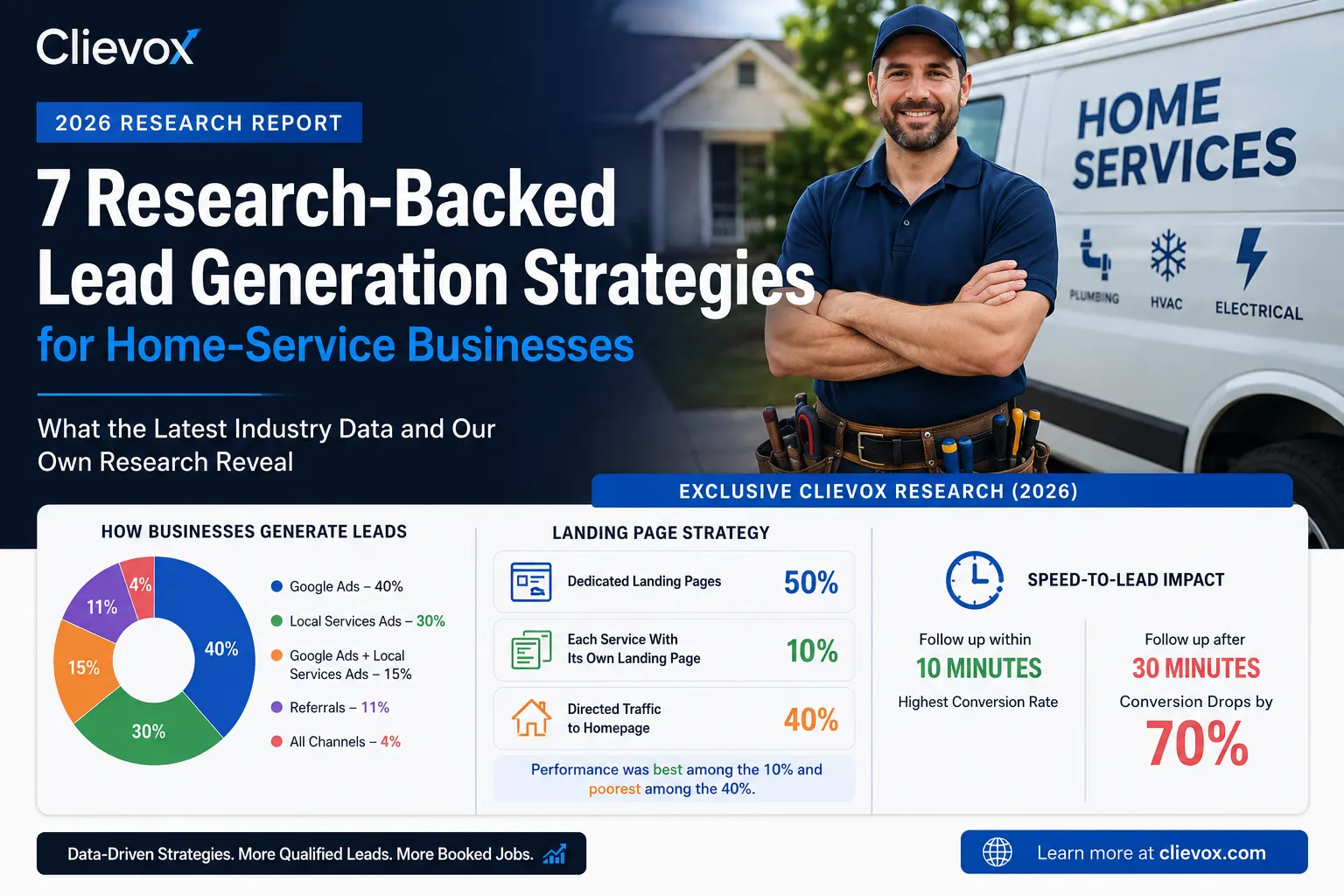
Primary Lead Generation Channels
| Strategy | Businesses Using It |
|---|---|
| Google Ads | 40% |
| Local Services Ads | 30% |
| Google Ads + Local Services Ads | 15% |
| Primarily Referrals | 11% |
| Combination of All Channels | 4% |
One finding stood out immediately.
Eighty-five percent of businesses relied on Google's advertising ecosystem, either through Google Ads, Local Services Ads or a combination of both. Only a small percentage depended primarily on referrals alone.
For growing contractors, this suggests that relying exclusively on word-of-mouth may limit future growth, especially in competitive markets.
1. Build Your Marketing Around High-Intent Google Searches
Someone searching for "emergency plumber near me" has a very different intent from someone casually browsing Facebook.
High-intent searches usually produce better-quality enquiries because the homeowner already needs a solution.
Focus your SEO and Google Ads campaigns around service-specific searches such as:
AC repair
Furnace installation
Emergency plumbing
Roof replacement
Drain cleaning
Electrical repair
Rather than sending every visitor to your homepage, direct them to pages specifically designed around the service they searched for.
2. Google Business Profile Is Still One of Your Most Valuable Assets
A well-optimized Google Business Profile increases visibility in Google Maps and local search results.
Every profile should include:
Accurate business information
Correct service categories
Service-area coverage
Recent project photos
Updated business hours
Customer reviews
Appointment links
Instead of measuring profile views, track what matters:
Calls
Quote requests
Website visits
Booked jobs
Those metrics directly contribute to business growth.
3. Dedicated Landing Pages Consistently Outperform Homepages
One of the most interesting findings from our research involved where businesses sent their advertising traffic.
Destination for Paid Traffic
| Destination | Businesses |
|---|---|
| Dedicated landing pages | 50% |
| Separate landing page for every service | 10% |
| Homepage | 40% |
Although only 10% of businesses created a unique landing page for every service, they consistently achieved the strongest overall marketing performance.
Businesses sending visitors to their homepage performed the worst.
This makes sense.
A homeowner searching for air conditioner repair wants immediate confirmation that you solve that specific problem—not a general overview of your company.
A dedicated service page answers their questions faster, reduces friction and increases the likelihood that they will contact your business.
4. Google Ads Works Best When Performance Is Measured Correctly
WordStream and LocaliQ analyzed more than 13,000 U.S. Google Ads campaigns between April 2025 and March 2026.
For Home and Home Improvement businesses, median benchmarks were:
Average CPC: $8.33
Average conversion rate: 8.05%
Average cost per lead: $90.92
These numbers provide useful benchmarks, but they shouldn't become your primary success metric.
Instead, monitor:
Cost per qualified lead
Lead-to-booking rate
Customer acquisition cost
Revenue generated
Gross profit
Return on advertising spend
A campaign producing fewer but higher-quality leads often delivers a better return than one generating a large volume of low-quality enquiries.
5. Speed-to-Lead Can Make or Break Your Conversion Rate
Generating leads is only half the equation.
How quickly you respond matters just as much.
What Clievox Found
Our research identified a strong relationship between response time and conversion performance.
Businesses that contacted new enquiries within the first 10 minutes consistently achieved the highest conversion rates.
When the initial follow-up occurred 30 minutes or later, conversion performance within our sample declined by approximately 70%.
Although every business operates differently, the pattern was remarkably consistent.
For contractors, this highlights the importance of:
Answering calls promptly
Using SMS confirmations
Automating lead notifications
Contacting form submissions immediately
Following up while the customer is still actively comparing providers
Speed builds trust—and often determines who wins the job.
6. Reviews Continue to Influence Buying Decisions
BrightLocal's 2026 Local Consumer Review Survey found:
47% of consumers won't use businesses with fewer than 20 reviews.
74% look for reviews written within the previous three months.
92% consider star ratings when choosing a local business.
These findings show that reviews are no longer optional.
Every completed job should trigger a simple review request.
An effective process is straightforward:
Confirm customer satisfaction.
Send a review link by SMS or email.
Send one reminder if needed.
Respond professionally to every review.
Authentic, recent reviews help convert more of the traffic your marketing already generates.
7. Don't Ignore Existing Customers
Many businesses spend thousands acquiring new customers while overlooking the people who already trust them.
Existing customers can generate additional revenue through:
Maintenance reminders
Seasonal inspections
Equipment replacement campaigns
Membership renewals
Warranty reminders
Referral requests
ServiceTitan also found that 41% of consumers actively look for financing options, and businesses offering financing experienced higher close rates and larger average tickets within its platform data.
Retaining and re-engaging existing customers is often more cost-effective than constantly searching for new ones.
The Biggest Takeaway
The best-performing home-service businesses don't rely on a single marketing tactic.
They combine:
Google Ads
Local Services Ads
Google Business Profile
Service-specific landing pages
Fast follow-up
Strong reviews
Customer retention
Perhaps the biggest lesson from both industry research and our own findings is this:
Marketing generates opportunities, but systems generate revenue.
You can double your advertising budget, but if leads wait 30 minutes for a response or every campaign sends visitors to your homepage, much of that investment will be wasted.
At Clievox, we help home-service businesses build marketing systems that focus on what actually matters—qualified leads, booked jobs and measurable business growth.
Research Methodology
Industry benchmarks referenced in this article are sourced from ServiceTitan, CallRail, BrightLocal, and WordStream/LocaliQ.
Clievox Research (2026) is based on our internal analysis of home-service business marketing strategies and conversion practices. The findings are intended to provide practical insights into observed marketing patterns within our sample and should not be interpreted as universal industry benchmarks. Performance varies depending on location, competition, service category, sales process and operational efficiency.