Every Click Is an Opportunity, Don't Let Your Landing Page Waste It
Generating traffic is only half the battle. Whether you're investing in Google Ads, Meta Ads, email marketing, or SEO, every visitor who lands on your website represents a potential customer. The real challenge begins after they arrive. If your landing page fails to convince them to take the next step, every click becomes a missed opportunity and every marketing dollar works harder than it should.
Many businesses assume poor campaign performance is caused by ineffective advertising, so they increase their budgets or experiment with new marketing channels. While attracting more visitors may seem like the obvious solution, it rarely fixes the underlying problem. If your landing page isn't converting the traffic you're already paying for, bringing in more visitors simply means more people leave without becoming leads.
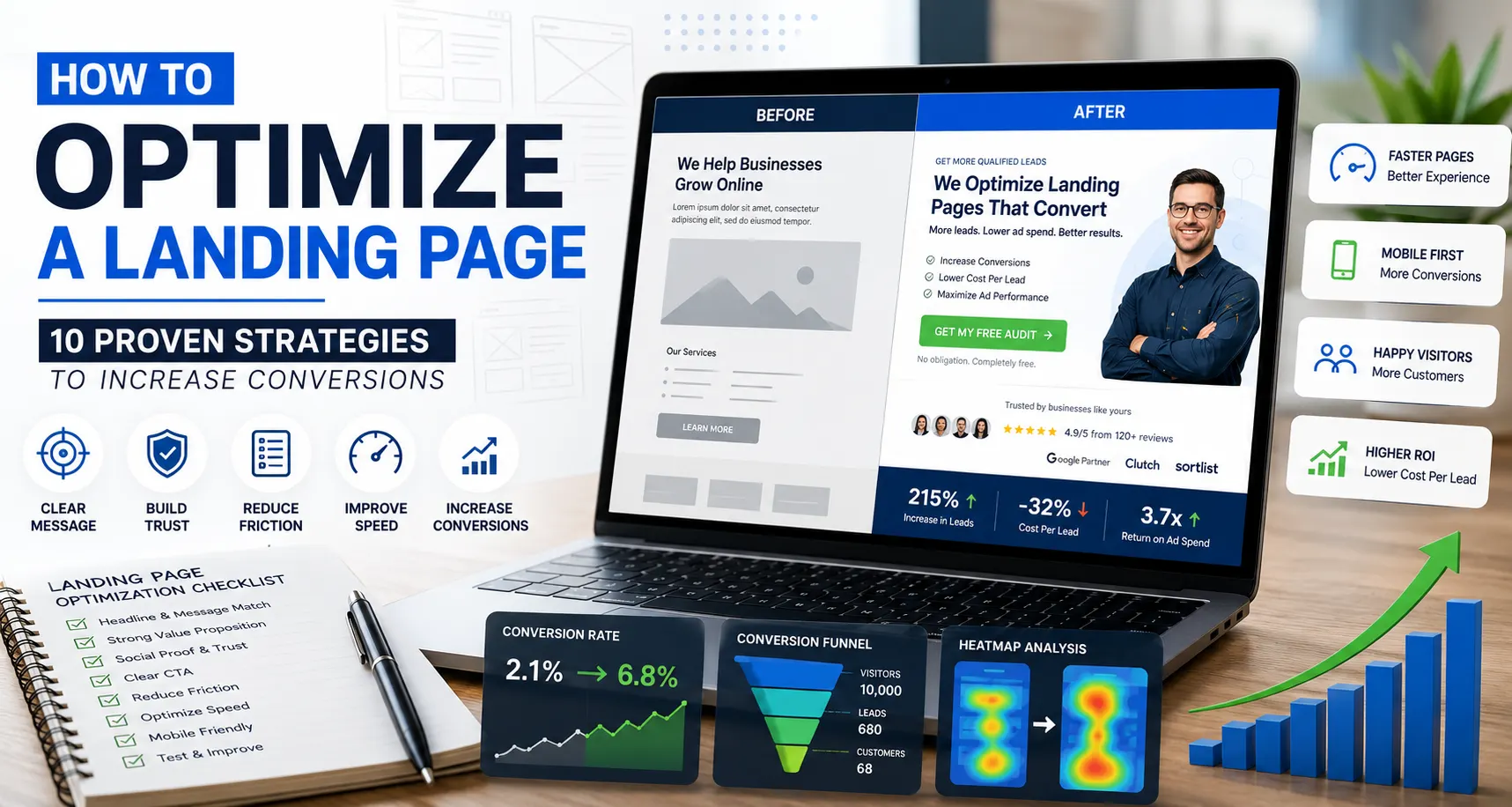
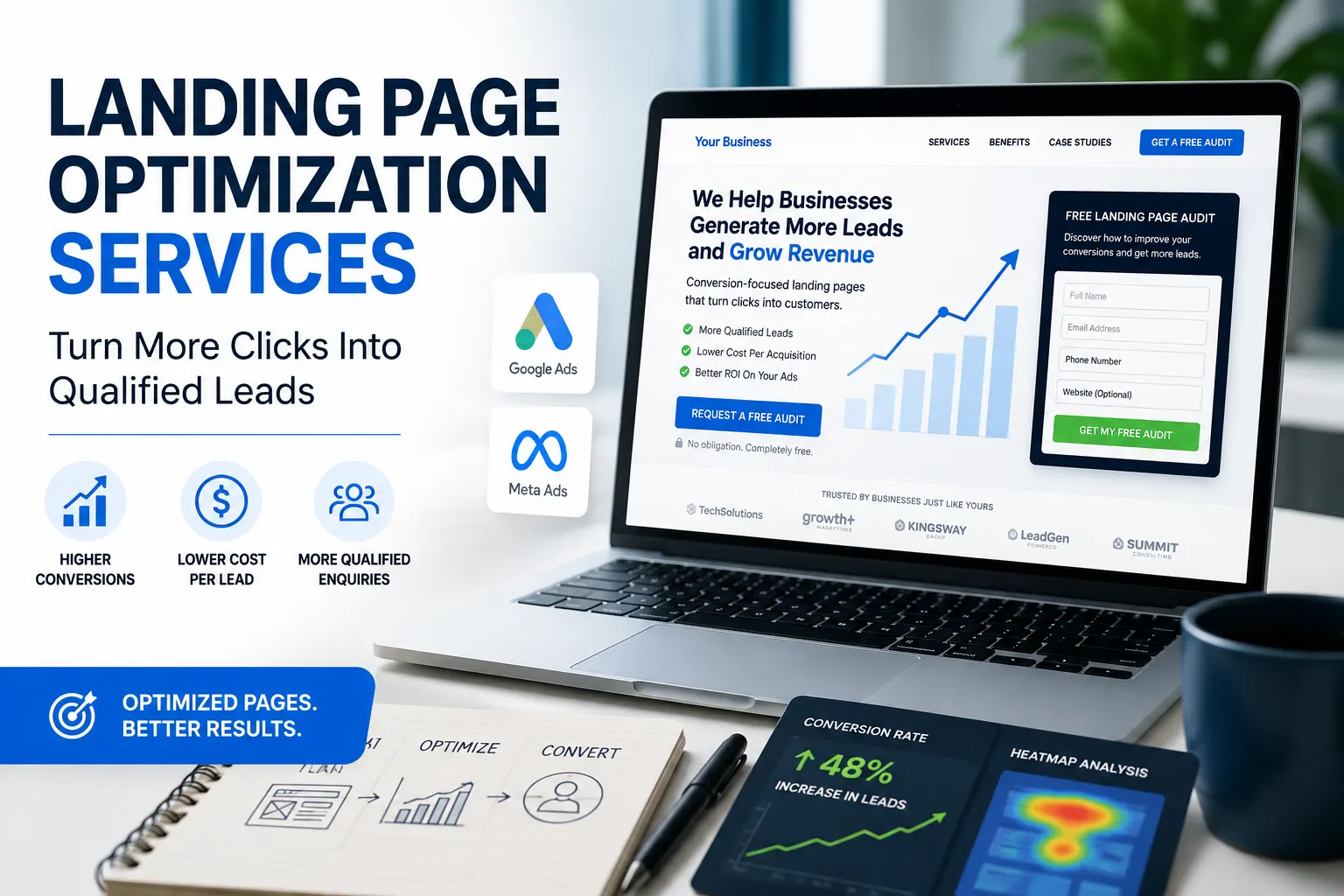
Landing page optimization services help businesses solve this problem by improving the pages where conversions actually happen. Instead of focusing on generating more clicks, the goal is to make every click more valuable. Through better messaging, stronger user experience, persuasive copy, and continuous testing, an optimized landing page can significantly increase enquiries, lower your cost per lead, and improve the return on your marketing investment.
Whether you're a local service business looking to generate more quote requests or a B2B company running lead generation campaigns, an optimized landing page can become one of the most valuable assets in your marketing strategy.
In this guide, you'll learn what landing page optimization services include, why so many landing pages fail to convert, and what separates high-performing pages from those that simply attract visitors without generating results.
What Are Landing Page Optimization Services?
Landing page optimization services focus on improving the performance of dedicated webpages designed to generate leads or sales. Unlike a traditional website, which encourages visitors to explore multiple pages, a landing page has one objective: guiding visitors toward a single action, whether that's requesting a quote, booking a consultation, downloading a guide, or making a purchase.
Optimizing a landing page involves far more than changing colours, rearranging layouts, or redesigning buttons. Every element on the page influences how visitors perceive your business and whether they feel confident enough to convert. From the headline and supporting copy to the form, imagery, trust signals, and page speed, each component plays a role in reducing hesitation and encouraging action.
One of the most important aspects of optimization is ensuring the page matches the visitor's intent. Imagine someone searches Google for landing page optimization services and clicks your advertisement. They expect to land on a page explaining exactly that service, not a generic homepage listing every digital marketing solution you provide. When visitors immediately find the information, they were looking for, they're far more likely to stay engaged and continue through the page.
Professional landing page optimization also relies on data rather than assumptions. Instead of guessing which headline will perform better or how many fields a form should contain, specialists analyse user behaviour, measure conversion rates, review heatmaps, and run A/B tests to identify improvements. Small changes made using real performance data often produce substantial increases in lead generation over time.
Most importantly, landing page optimization isn't a one-time project. Customer expectations change, competitors refine their websites, and advertising platforms continue to evolve. Businesses that regularly review and improve their landing pages consistently outperform those that treat them as finished projects.
Why Most Landing Pages Don't Convert
If you've ever wondered why your advertising campaigns generate clicks but very few enquiries, the answer often lies with your landing page rather than your ads.
Visitors don't arrive on your website ready to become customers. They arrive with questions, doubts, and several competing options only a click away. Your landing page needs to answer those questions quickly and build enough confidence for visitors to take the next step.
One of the most common mistakes businesses make is sending paid traffic to their homepage. While a homepage serves as an introduction to your company, it's rarely designed to convert visitors from a specific campaign. Navigation menus, multiple services, blog articles, and competing calls-to-action create distractions that make it harder for visitors to focus on the action you actually want them to take.
Imagine someone searching for an emergency electrician after losing power at home. They click an advertisement promising same-day service but arrive on a homepage discussing residential installations, commercial projects, company history, and careers. Instead of immediately finding the information they need, they're forced to search for it themselves. Most won't. They'll simply return to Google and choose another business.
Weak messaging creates another barrier to conversion. Businesses often focus on describing what they do rather than explaining how they solve customer problems. Visitors aren't looking for lengthy company biographies or technical descriptions of your services. They want reassurance that you understand their situation and can deliver the outcome they're looking for.
Trust also plays a significant role in every conversion decision. Before sharing their contact details, visitors want evidence that your business is credible and reliable. Customer reviews, testimonials, certifications, guarantees, awards, and examples of previous work all help reduce perceived risk. Without these trust signals, even well-designed landing pages struggle to convert because visitors have little reason to choose your business over the competition.
Technical issues can be equally damaging. Slow loading pages, poor mobile experiences, difficult navigation, and lengthy forms all create friction that discourages enquiries. Today's visitors expect websites to load quickly and provide a seamless experience across every device. If your landing page feels frustrating to use, they'll leave long before they reach your call-to-action.
The encouraging news is that these problems are usually fixable. You don't always need to increase your advertising budget to generate more leads. In many cases, improving the landing page itself produces better results because every future visitor benefits from a smoother, more persuasive experience.
In the next section, let us explore the seven essential elements that consistently separate high-converting landing pages from those that fail to turn traffic into qualified customers.
The 7 Elements of a High-Converting Landing Page
Every successful landing page follows the same principle: it makes it easy for visitors to understand your offer, trust your business, and take the next step. While every industry is different, high-converting pages are rarely built by chance. They combine persuasive messaging, thoughtful design, and a seamless user experience to remove doubt and encourage action.
If your current landing pages aren't generating the enquiries you expect, these are the seven areas worth improving first.
1. A Clear Hero Section and Headline
Your hero section is your first opportunity to make a positive impression, and visitors often decide within a few seconds whether they'll continue reading or leave your website. Instead of trying to be clever, focus on being clear. Your headline should immediately explain what you offer, who it's for, and the value visitors can expect.
For example, if someone clicks a Google Ad for Landing Page Optimization Services, the first thing they should see is a headline that reinforces that promise. A supporting subheading can then explain how your service helps businesses generate more leads, reduce cost per acquisition, or improve campaign performance. When visitors instantly recognise they've found the right solution, they're far more likely to continue through the page.
2. A Strong Offer That Gives Visitors a Reason to Act
Even if visitors believe your business can help them, they still need a compelling reason to contact you today instead of postponing the decision. That's where a clear offer becomes essential.
Depending on your business, this might be a free consultation, a landing page audit, a customized proposal, or a no-obligation strategy session. The offer doesn't always need to involve a discount. In many cases, reducing uncertainty is more valuable than lowering the price.
Ask yourself one simple question: What does the visitor gain by filling out this form? If the answer isn't immediately obvious, your offer probably needs strengthening.
3. Trust Signals and Social Proof
Before contacting your business, visitors want reassurance that they'll be making the right decision. Since they haven't worked with you before, they'll naturally look for evidence that other people have.
Customer testimonials, Google reviews, case studies, industry certifications, awards, client logos, and guarantees all help reduce perceived risk. Together, these trust signals reassure potential customers that your business has delivered results for others and can do the same for them.
Whenever possible, make your testimonials specific. A review explaining how your optimization work doubled a client's enquiries is far more persuasive than a generic comment about excellent service. Authentic experiences build credibility because they help visitors imagine achieving similar results.
4. A Simple User Journey
One of the biggest reasons people leave landing pages without converting is uncertainty about what happens next. They don't know how long the process takes, whether they'll receive a sales call immediately, or what they're actually committing to.
A simple process section removes these concerns by explaining the journey step by step. For example, visitors might first request a free consultation, then speak with a specialist, receive tailored recommendations, and finally decide whether to proceed.
This transparency makes the experience feel predictable rather than intimidating. When visitors understand the process, completing your form becomes much easier because there are fewer unknowns standing in the way of a decision.
5. Clear Calls-to-Action
A landing page should always have one primary goal, and your call-to-action should make that goal obvious.
Buttons labelled Submit or Learn More don't communicate much value because they focus on the action instead of the outcome. Instead, use language that reinforces the benefit visitors receive, such as Request My Free Audit, Book My Consultation, or Get My Custom Quote.
Your calls-to-action should also appear naturally throughout the page rather than only at the bottom. After reading a testimonial or learning about your offer, some visitors will already be ready to take action. Giving them an opportunity to convert without unnecessary scrolling creates a smoother experience and often improves conversion rates.
6. Fast, Mobile-Friendly Performance
A beautifully designed landing page won't generate leads if visitors abandon it before it finishes loading. Website speed has a direct impact on user experience, and even small delays can increase bounce rates significantly.
Performance optimization includes compressing images, reducing unnecessary scripts, improving Core Web Vitals, and ensuring pages load quickly across all devices. Just as importantly, your landing page should be designed with mobile users in mind.
Most businesses now receive a large percentage of their traffic from smartphones, which means visitors expect clear layouts, easy-to-read content, simple forms, and buttons that are easy to tap. Testing your landing page on multiple devices helps ensure every visitor enjoys the same seamless experience regardless of screen size.
7. Short Forms and Continuous Optimization
The contact form is where visitors finally decide whether to become a lead, so it should feel as effortless as possible. Asking for unnecessary information often creates resistance because people question why so many details are required before they've even spoken to someone.
In most cases, a name, email address, phone number, and a brief message are enough to begin the conversation. Additional information can always be collected later during a consultation or discovery call.
Landing page optimization doesn't end once the page goes live. The highest-performing businesses continually test headlines, calls-to-action, layouts, offers, and forms to understand what resonates with their audience. Small improvements made over time often deliver substantial gains in conversion rates, making optimization an ongoing investment rather than a one-time project.
Why Choose Clievox for Landing Page Optimization?
At Clievox, we believe successful landing pages are built on strategy rather than guesswork. Every recommendation we make is backed by user behaviour, conversion best practices, and a clear understanding of your customers' needs.
Our landing page optimization services combine persuasive copywriting, conversion-focused design, user experience improvements, technical performance, and ongoing testing to help businesses generate more qualified leads without increasing their advertising spend. Instead of relying on assumptions, we analyze how visitors interact with your page, identify conversion barriers, and implement improvements that deliver measurable results.
Whether you're running Google Ads, Meta Ads, local lead generation campaigns, or investing in SEO, we build landing pages that align with visitor intent and support your broader marketing objectives.
Frequently Asked Questions
How long does landing page optimization take?
Some improvements can increase conversions almost immediately, while ongoing testing and refinement deliver stronger long-term results.
Can landing page optimization improve my Google Ads performance?
Yes. Higher conversion rates often reduce your cost per lead because more visitors take action without requiring additional advertising spend.
Should every advertising campaign have its own landing page?
Ideally, yes. Dedicated landing pages provide better message match, improve user experience, and typically outperform sending visitors to a generic homepage.
Ready to generate more leads from your existing traffic? Contact Clievox today to schedule a landing page audit and discover how strategic optimization can transform your campaign performance.